This article is general information, not medical advice. Talk with a licensed clinician before making any decision about your care.
Home blood pressure monitors in 2026: what doctors actually recommend
If you’ve stood in the pharmacy aisle staring at a wall of blood pressure cuffs, you already know the problem. Roughly half the boxes promise clinical accuracy. A much smaller fraction can actually prove it. The American Medical Association and American Heart Association now publish a public list of devices that passed an independent accuracy review, and the gap between that list and the rest of the market is wider than most shoppers realize.
Why “validated” is the only label that matters
When the AMA launched the U.S. Blood Pressure Validated Device Listing, only 16 home monitors met its standards. The list has since grown to 25 device models from five manufacturers — A&D Medical, Hillrom-Welch Allyn, Microlife, Omron, and PharmaSmart — reviewed by an independent committee of physicians convened at NORC at the University of Chicago. Manufacturers submit their own clinical data; the committee approves or rejects on a rolling basis. You can search the current listing at ValidateBP.org.
“FDA-cleared” is not the same thing. FDA clearance is essentially about safety and general performance, not whether a device’s readings match an artery-line gold standard within a few millimeters of mercury. A device can be FDA-cleared and still drift several points off a clinic reading — which sounds small until you remember that the boundary between Stage 1 hypertension and “elevated” is exactly that narrow.
Cardiologists and primary-care groups, including those cited by AARP’s 2026 monitor review, recommend an automated, upper-arm, cuff-style monitor and nothing else. AARP’s testing named the A&D Medical Premium its top overall pick and the Omron 3 Series its best value; both appear on the AMA validated list. Price tells you very little about accuracy. A $50 validated cuff will outperform a $300 unvalidated gadget every time.
Are wrist monitors and smartwatches good enough?
Short answer: no.
The American Heart Association is explicit that wrist and finger monitors give less reliable readings, and that cuffless devices — including the new generation of smartwatches that estimate blood pressure from optical signals — should not be relied on for clinical decisions until precision improves. Wrist arteries are smaller and harder to pin at heart level; finger pulses don’t translate cleanly into the systolic and diastolic numbers your doctor uses to titrate medication.
That doesn’t mean every wrist monitor is useless for casual trend-spotting. It means you shouldn’t make medication or treatment decisions on its numbers, and you shouldn’t use one as your only home device. If you have very large upper arms, very thin arms, or a condition that makes upper-arm cuffs painful, ask your clinician whether a validated wrist cuff fit-tested in the office is an acceptable backup. For everyone else, the upper-arm cuff is the answer.
Cuff size matters as much as brand. Most validated monitors ship with a standard adult cuff sized roughly 8.6 to 17 inches around the upper arm; if your bicep falls outside that window, a too-small cuff reads artificially high and a too-large cuff reads artificially low. Manufacturers sell large and extra-large cuffs separately for $20 to $30. Buying the right cuff for your arm is more important than buying a fancier monitor.
The technique that makes a $40 cuff agree with the clinic
This is where most home readings go wrong, and it has almost nothing to do with the device. The Centers for Disease Control and Prevention’s home measurement guide reads like a checklist a nurse would tape to your bathroom mirror — which is roughly how seriously to take it.
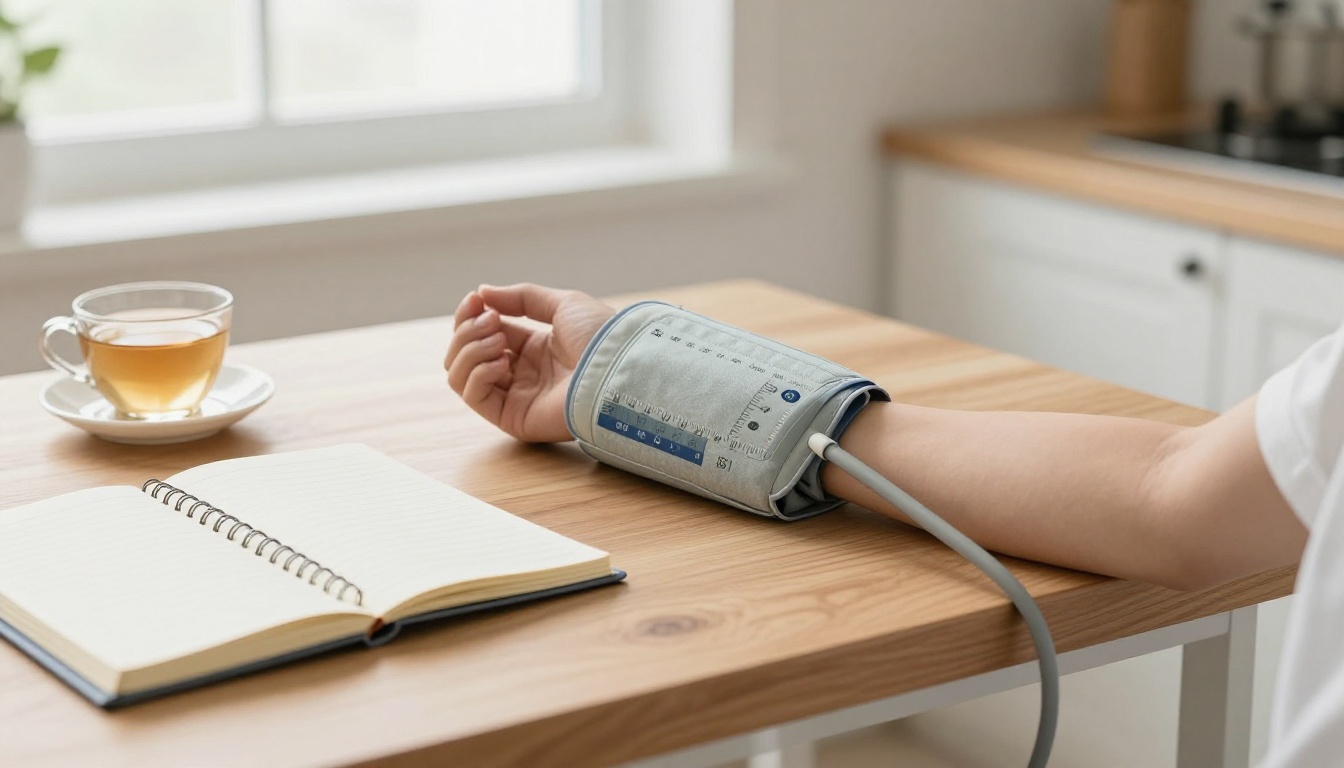
Don’t eat, drink caffeine, smoke, or exercise within 30 minutes of measuring. Empty your bladder. Sit in a chair with your back supported for a full five minutes before the cuff inflates, both feet flat on the floor, legs uncrossed. Put the cuff on bare skin, snug but not tight, with the bottom edge about an inch above the elbow crease. Rest your arm on a table so the cuff is at heart level. Don’t talk. Don’t look at your phone. Take two readings a minute or two apart, and write down both.
A reading taken with your legs crossed or your arm hanging at your side can run 10 mm Hg higher than the same arm rested on a table. Talking during a measurement can add another 10. Stack two or three of those small errors and an otherwise-controlled blood pressure looks like uncontrolled hypertension — which can lead to medication changes that weren’t actually needed.
The National Heart, Lung, and Blood Institute suggests doing this twice a day for a week before any clinic appointment where medication adjustments are on the table. Morning, before pills and coffee. Evening, before dinner. Average the readings across the week and bring the log to your doctor. That single habit is what gets home monitors mentioned in the same sentence as “lower blood pressure” in the research literature — not the cuff itself, but the cuff plus a routine plus a conversation.
For people already managing hypertension, this changes the relationship with your clinician. Instead of one office reading every three months (which the white-coat effect can inflate by 10 to 20 points), the doctor sees 14 datapoints from your actual life. That’s why the federal Million Hearts initiative calls self-measured blood pressure with clinical support one of the highest-leverage interventions in cardiovascular care. If you want the deeper story on what those numbers actually mean, our explainer on the 2026 blood pressure targets walks through the current AHA and ACC thresholds.
What Medicare covers, and what it doesn’t
Here’s the part that frustrates many readers. Original Medicare doesn’t cover a basic home blood pressure cuff under almost any circumstance. Part B covers ambulatory blood pressure monitors — the 24-hour devices a clinic loans out to diagnose suspected white-coat hypertension — and it covers home cuffs for patients on home dialysis. That’s essentially it. Standard self-measurement cuffs are an out-of-pocket purchase for most beneficiaries.
Some Medicare Advantage plans bundle a free or discounted monitor into their over-the-counter benefit, which is one of several reasons it pays to compare plans during open enrollment. Our guide to Medicare Advantage versus Original Medicare in 2026 walks through how that benefit varies plan to plan. If you have an FSA or HSA, a home blood pressure monitor is a qualified medical expense under IRS rules, so you can pay with pre-tax dollars even when your insurance won’t reimburse the device. The narrow exceptions for Original Medicare are documented at the Medicare.gov coverage finder, which is also where you can check whether your specific situation qualifies.
A reasonable budget is $40 to $100 for a validated upper-arm monitor with a standard cuff. Bluetooth syncing and app-based tracking add $20 to $50 and aren’t required — a built-in memory and a paper log work fine. Premium features like multi-user profiles, advanced arrhythmia detection, or cuff-on-bicep guidance lights mostly help households where two people share a device or where dexterity is an issue.
What to remember
A home blood pressure monitor is one of the few medical purchases where the decision is mostly binary: a validated upper-arm cuff, or not worth the box it came in. Get the cuff size right for your arm, follow the five-minute rest and same-arm-at-heart-level technique every time, and average a week of readings before any conversation about medication. The cuff is a tool; the routine is what changes outcomes. Talk to your clinician before changing any prescription based on what your monitor shows.
Sources
- Centers for Disease Control and Prevention. “Measuring Your Blood Pressure.” 2024. https://www.cdc.gov/high-blood-pressure/measure/index.html
- American Medical Association. “BP monitoring you can count on—list of validated devices grows.” 2023. https://www.ama-assn.org/public-health/prevention-wellness/bp-monitoring-you-can-count-list-validated-devices-grows
- AARP. “Best Blood Pressure Monitors of 2026.” 2026. https://www.aarp.org/health/conditions-treatments/best-blood-pressure-monitors/
- American Heart Association. “Monitoring Your Blood Pressure at Home.” 2024. https://www.heart.org/en/health-topics/high-blood-pressure/understanding-blood-pressure-readings/monitoring-your-blood-pressure-at-home
- National Heart, Lung, and Blood Institute. “High Blood Pressure.” 2024. https://www.nhlbi.nih.gov/health/high-blood-pressure
- Million Hearts / U.S. Department of Health and Human Services. “Self-Measured Blood Pressure Monitoring.” 2024. https://millionhearts.hhs.gov/tools-protocols/tools/smbp.html
- Centers for Medicare & Medicaid Services. “Medicare coverage finder.” 2026. https://www.medicare.gov/coverage