This article is general information, not medical advice. Talk with a licensed clinician before making any decision about your care.
Strength training after 60: a four-week starter plan grounded in the 2026 research
If you are over 60 and have never lifted a weight in your life, the most important thing to know is this: starting now still works. The American College of Sports Medicine released its first major resistance-training update in 17 years this spring, and the single loudest message in the document is that consistency beats complexity. Two short sessions a week, done for a month, will already begin to push back against the muscle loss that quietly accelerates after 50.
This is a starter plan, not a prescription. It maps the federal physical-activity guidance for adults 65 and older onto a four-week schedule you can do at home with a chair, a wall, and a set of resistance bands.
Why strength training matters more after 60
Adults begin losing muscle mass and power gradually in their 30s, and the pace picks up after 60. Left alone, that decline — known as sarcopenia — chips away at balance, walking speed, and the ability to stand up from a low chair. It is also a key reason that, according to the Centers for Disease Control and Prevention, about one in four Americans aged 65 or older falls each year, and roughly 3 million end up in emergency departments for fall-related injuries.
Resistance training is the most direct counter-move. The Mayo Clinic notes that strength work can slow and, in many cases, reverse the muscle-fiber changes associated with aging, even in people who didn’t start until after age 70. AARP frames it bluntly: the goal is “building up and maintaining a level of muscle strength so that you can remain physically and mentally independent.”
That payoff matters as much as the numbers on a scale. A stronger lower body is what lets you carry groceries up the porch steps, get off the floor after playing with a grandchild, and — quietly, day after day — not fall.
What do the guidelines actually say?
The CDC asks adults 65 and older to put three things on the weekly calendar. First, at least 150 minutes of moderate-intensity aerobic activity, which can be 30 minutes of brisk walking on five days. Second, muscle-strengthening activity on at least two days, hitting all the major muscle groups — legs, hips, back, abdomen, chest, shoulders, and arms. Third, balance work, which is unique to the over-65 recommendation.
The ACSM’s 2026 Position Stand, which synthesized 137 systematic reviews covering more than 30,000 participants, reinforced the same baseline. Train each major muscle group at least twice a week, progress the load over time, and accept that the best program is the one you’ll actually do. For pure strength, the panel pointed to heavier loads (around 80 percent of a one-rep maximum) for two to three sets. For older adults specifically, the group emphasized moderate loads, lower training volume, and moving the weight with intent on the lifting phase to preserve power — the explosive piece of strength that fades first.
Translated into English: you do not need to live at the gym. You need to show up twice a week and gradually do a little more.
A four-week starter program you can do at home
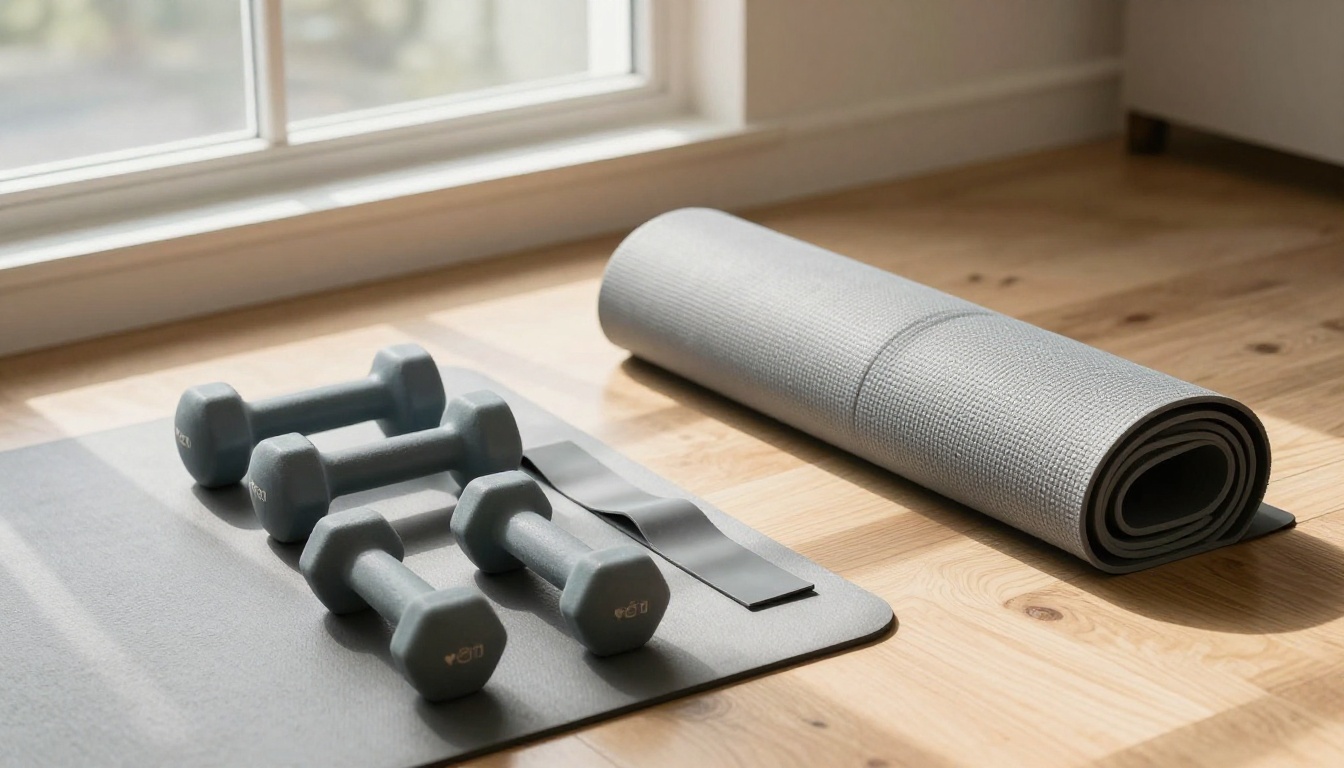
The plan below uses seven movements that cover all the major muscle groups the CDC lists, plus a balance drill. You’ll need a sturdy chair without wheels, a wall, one set of light-to-medium resistance bands, and clear floor space. Plan on roughly 25 minutes per session, with at least one rest day between sessions — the rest is when the muscle actually rebuilds.
Before each session, warm up for five minutes by walking around the house, marching in place, or stepping side-to-side. Cold muscles strain more easily.
The seven movements
- Sit-to-stand from a kitchen chair (legs, hips, core)
- Wall push-up or counter push-up (chest, shoulders, arms)
- Seated band row, anchoring the band around your feet (upper back, biceps)
- Standing band overhead press (shoulders, arms)
- Standing calf raise, holding the counter for balance (lower legs)
- Bird-dog on hands and knees, opposite arm and leg extended (core, back)
- Heel-to-toe walk along a hallway (balance)
Week 1 — Foundation. Two sessions, three days apart. Do one set of 10 repetitions of each strength movement, then 30 seconds of heel-to-toe walking. The first week is about learning the pattern. If 10 reps feels too easy, that is fine; you’ll add load and volume soon.
Week 2 — Build. Same two sessions, same seven movements, but raise each strength exercise to 12 repetitions. Hold the standing calf raise at the top for a one-second pause. Extend the heel-to-toe walk to 45 seconds. You should feel mildly tired by the last two reps of each set, not exhausted.
Week 3 — Progress. Add a second set of every strength movement, keeping reps at 10 to 12. Rest about a minute between sets. The Mayo Clinic notes that a single set of 12 to 15 repetitions at the right resistance can build muscle efficiently, but adding a second set is how most beginners keep progressing once form is solid.
Week 4 — Consolidate. Move to three sessions if it feels manageable; otherwise, stay at two. Step up to a slightly heavier resistance band or add a small hand weight (a full water bottle works) to the overhead press and row. On the sit-to-stand, try to do the last two reps with arms folded across your chest — no hand assist from the chair.
By the end of week four, you’ll have done eight to twelve sessions and hit each muscle group at least twice every week, which is exactly what the CDC and ACSM recommend as a floor.
What about safety, soreness, and starting too hard?
The honest answer? Some muscle soreness 24 to 48 hours after a session is normal, especially in the first two weeks. Sharp joint pain is not. If something pinches, you stop and change the movement, not push through.
The Mayo Clinic recommends that anyone over 40 who hasn’t been active recently — and anyone with a chronic condition such as heart disease, high blood pressure, diabetes, or arthritis — talk to a clinician before beginning a new strength program. That conversation can take five minutes at a Medicare annual wellness visit. It is not a barrier; it is a check that the plan fits your specific medications and joints. (This article is general health information, not a substitute for advice from your own doctor.)
AARP’s coaches make a related point: rest at least one day between strength sessions, especially at the start, because the muscle adapts during recovery and not during the workout itself. If your knees ache the morning after sit-to-stands, the body is asking for an extra rest day, not a tougher session.
One more piece of context that doesn’t fit neatly under safety but matters: strength gains and fall prevention move together. A program that builds leg strength and adds even a few minutes of balance practice each session — the heel-to-toe walk above is the simplest version — is closer to what the CDC’s fall-prevention research has shown to work. If you are also worried about hazards at home, our guide to fall prevention and home modifications covers the grab bars, lighting, and rug fixes that pair naturally with a stronger lower body.
What to do after week four
Two paths open up. Most beginners stick with the same seven movements for another four to eight weeks and slowly increase the resistance, the number of sets, or the speed of the lifting phase. Others, once the chair squat feels easy and a heavier band no longer challenges the row, graduate to a community fitness class, a senior center, or a few sessions with a trainer who can introduce free weights or machines safely.
Either path counts. The 2026 ACSM panel was explicit that nontraditional training — bands, bodyweight, home routines — is highly effective when it is done consistently. The trap is not your equipment. It is quietly skipping sessions until the habit fades.
A few practical anchors help. Put the two weekly sessions on the calendar at the same times you already do something else (Tuesday after the morning walk, Saturday before lunch). Keep the bands visible, not in a drawer. And pair the new habit with sleep, which is when the body does most of its repair — our overview of what helps sleep after 60 walks through the small adjustments that make recovery easier.
Is starting at 65 too late to matter? The research keeps answering the same way: no.
What to remember
The CDC asks for two strength sessions a week, on all major muscle groups, plus balance work. The ACSM’s 2026 update confirms that simple, consistent training beats complicated programs. A four-week starter plan built around seven home movements is enough to meet that bar and to begin pushing back against muscle loss, weakness, and fall risk. Talk to your clinician before you begin if you have a chronic condition or have been sedentary, then start small and let the habit, not the heavy weights, do the work.
Sources
- Centers for Disease Control and Prevention. “Older Adult Activity: An Overview.” 2025. https://www.cdc.gov/physical-activity-basics/guidelines/older-adults.html
- Centers for Disease Control and Prevention. “Adult Activity: An Overview.” 2025. https://www.cdc.gov/physical-activity-basics/guidelines/adults.html
- Centers for Disease Control and Prevention. “Falls Compendium.” 2025. https://www.cdc.gov/falls/interventions/falls-compendium.html
- Mayo Clinic. “Strength training: Get stronger, leaner, healthier.” 2025. https://www.mayoclinic.org/healthy-lifestyle/fitness/in-depth/strength-training/art-20046670
- American College of Sports Medicine. “ACSM Unveils Landmark 2026 Resistance Training Guidelines — First Update in 17 Years.” 2026. https://acsm.org/resistance-training-guidelines-update-2026/
- AARP. “Strength Training Burns Body Fat, Increases Longevity.” 2025. https://www.aarp.org/health/healthy-living/strength-training/